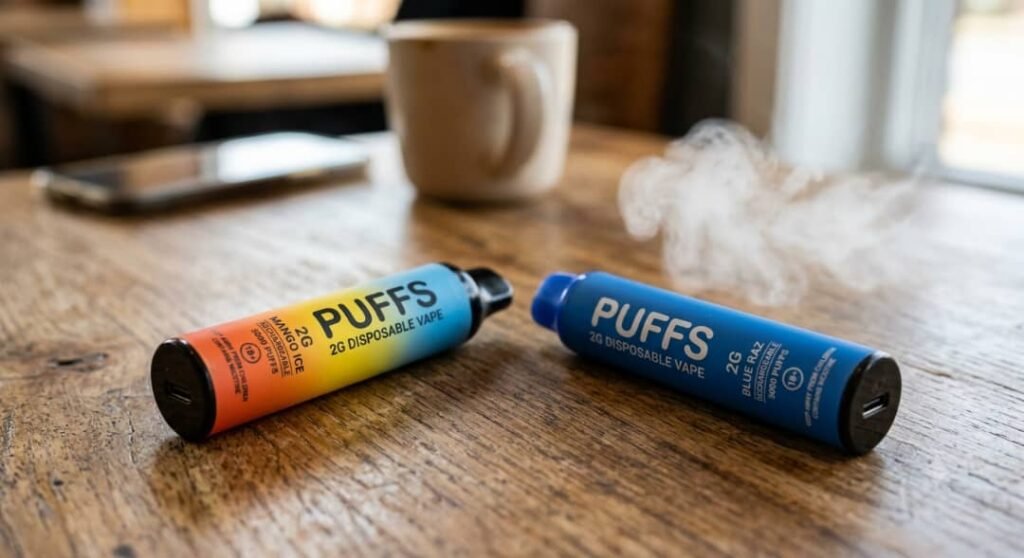
How Many Puffs Are in a 2G Disposable Vape? What Affects Puff Count?
If you've seen a disposable vape labeled 2G, you may have wondered how many puffs you can actually expect from it. The answer isn't as simple as multiplying the amount of oil by a fixed number because puff count can vary considerably depending on the device, draw length, airflow, battery performance, and individual usage.
In this guide, we'll explain what the 2G label means, why advertised puff counts can differ from real-world results, and which factors have the biggest effect on how long a device lasts.
What Does 2G Mean on a Disposable Vape?
The "2G" designation generally refers to approximately 2 grams of vape oil or concentrate contained in the device.
It does not mean that every 2G disposable contains the same formulation, hardware, or expected puff count. Two devices with the same labeled quantity can perform differently because manufacturers may use different heating elements, airflow systems, batteries, and oil formulations.
That's why the 2G label should be viewed primarily as an indication of the amount of material in the device rather than a guaranteed number of puffs.
How Many Puffs Can a 2G Disposable Vape Provide?
There isn't one universal puff count for every 2G disposable.
The actual number depends heavily on how the device is used. Short draws generally consume less material per puff than longer draws, while repeated long draws can reduce the total number of puffs considerably.
Manufacturers may publish an estimated puff count, but these figures are typically based on controlled testing conditions. Real-world results can be different.
For that reason, it's better to think of puff count as an estimate rather than a guarantee.
Why Puff Count Varies
Several factors influence how many puffs a 2G device can provide:
1. Draw Length
One of the biggest factors is how long each draw lasts. A short draw uses less oil than a long draw. If someone consistently takes longer draws, the device may reach empty sooner even though both users started with the same 2G quantity.
2. Device Hardware
Heating technology and airflow design can affect vapor production and material consumption. Different devices can therefore produce noticeably different results even when both are labeled 2G.
3. Airflow
Airflow affects how much vapor is produced during each draw. A device with an airflow system designed for larger vapor production may consume material differently from a device designed around smaller draws.
4. Battery Performance
Rechargeable devices may allow the user to continue using the remaining material after the initial battery charge has been depleted. Battery capacity and charging design therefore matter when considering the overall lifespan of a device.
5. Oil Formulation
The physical characteristics of the material inside the device can also affect vapor production and heating behavior. Different formulations may behave differently under the same hardware conditions.
Does a 2G Vape Last Twice as Long as a 1G Vape?
Not necessarily.
A 2G device contains roughly twice the labeled quantity of material compared with a 1G device, but that doesn't automatically mean the real-world lifespan will be exactly twice as long. Usage habits, device efficiency, draw length, and hardware design all influence the result.
The simplest way to think about it: More material generally means more potential use, but the actual lifespan depends on how that material is consumed.
Why Advertised Puff Counts Can Be Misleading
Puff-count numbers can be useful for comparison, but they shouldn't be treated as an exact measurement.
A manufacturer's testing method may use a standardized draw duration and interval. A real person may take significantly shorter or longer draws. For example, two people using identical devices could get different results simply because their draw lengths differ.
This is one reason why 2G quantity and advertised puff count should be considered separately.
How to Compare 2G Disposable Vapes
If you're researching different devices, don't look at puff count alone. Consider these key factors:
- Labeled oil quantity
- Stated puff estimate
- Battery capacity
- Rechargeability
- Heating technology
- Airflow design
- Product specifications
- Testing/Certifications
- Packaging authenticity
Looking at several specifications together provides a better picture than relying on a single puff-count number.
2G vs. 1G: What's the Difference?
The most obvious difference is the amount of material contained in the device. A 1G device is labeled for approximately 1 gram, while a 2G device is labeled for approximately 2 grams.
However, the physical size, battery, heating system, and design can vary significantly between products. The larger number doesn't automatically mean better hardware or a guaranteed specific lifespan.
Frequently Asked Questions
There is no universal number. Puff count depends on the manufacturer's testing method, draw length, hardware, airflow, and other factors.
No. "2G" refers to the labeled quantity of material, not a guaranteed number of puffs.
Generally, a device containing more material has more material available for use, but actual lifespan depends on individual usage and device characteristics.
Advertised puff counts are estimates based on specific testing conditions. Longer draws and different usage patterns can reduce the number of actual puffs.
Draw length and usage frequency are major factors, while hardware, airflow, battery design, and formulation can also affect overall performance.
Final Thoughts
A 2G disposable vape does not have one guaranteed puff count. The 2G label describes the approximate quantity of material, while the actual number of puffs depends on the device and how it is used.
When comparing products, treat advertised puff counts as estimates rather than guarantees and look at the complete set of product specifications.
For more information, see our related guide on what 2G means and how long a 2G disposable vape can last.
How many puffs are in a 2G disposable vape? Learn what 2G means, why puff counts vary, and which factors affect device lifespan.